Pompeo + Yermak = ???
VEON, Kyivstar, Mike Pompeo, Andriy Yermak — and several questions nobody seems eager to ask
A most curious little testimony to our times is still preserved on the website of VEON, in the section devoted to the stock-market debut of its Ukrainian asset, Kyivstar. In the video, amid a crowd of impossibly happy people experiencing something very close to euphoria — if not outright ecstasy — over the company’s arrival on Nasdaq, a gentleman of considerable height protrudes like a boil on a wedding cake.
His face wears an expression familiar to anyone born in the post-Soviet world. One may call it gloomy. One may call it displeased. Or one may call it nothing at all and merely observe that the man is defiantly not smiling at the precise moment when everyone else in the room, judging from their faces, has just been informed simultaneously of the arrival of world peace, the abolition of taxes, and their own immortality.
Anyone who has taken even a passing interest in Ukrainian politics in recent years will recognize the gentleman as Andriy Borysovych Yermak — patronymic included, as befitted the altitude he had attained. Until recently he was a man whose exact position in the hierarchy of power was difficult to describe: not quite the first person in the state, yet somehow not the second either. He was the head of Volodymyr Zelenskyy’s personal chancery and, by widespread understanding, one of the most powerful men in Ukraine.
At his right hand stands Mike Pompeo — former U.S. Secretary of State, former Director of the CIA, and a member of the boards of both VEON and Kyivstar. His smile, broad as Texas, is agreeably complemented by light-brown shoes beneath a dark-blue suit. Whether this arrangement is intended to symbolize the former chief diplomat’s Italian ancestry, the relaxed confidence of an accomplished businessman, or merely the possession of a pair of light-brown shoes, I am unable to determine.
Kyivstar began trading on Nasdaq on August 15, 2025. The Opening Bell ceremony at which Messrs. Yermak and Pompeo found themselves standing side by side took place on August 29, and VEON and Nasdaq quite officially list Yermak among the distinguished participants. This occurred exactly nine months after November 29, 2024, when Kyiv’s Shevchenkivskyi District Court lifted the seizure of 47.85 percent of VEON’s corporate rights in Kyivstar and removed the restrictions on VEON’s corporate rights in its other Ukrainian subsidiaries. It also occurred roughly eight and a half months before another Ukrainian court, in an entirely unrelated affair, ordered Mr. Yermak into custody with the possibility of bail: on May 14, 2026, Ukraine’s High Anti-Corruption Court ordered his detention and set bail at 140 million hryvnias, roughly $3.3 million. A few days later the bail was posted. Yermak denies the accusations.
This little history gives me occasion to ask several questions once again. I entertain no illusions about receiving answers to them in the foreseeable future, or perhaps in any future available to mankind. Still, I find the practice of asking questions in public rather useful — especially when a question is so simple that professional journalists somehow find it embarrassing to pronounce aloud.
Question One. For what, exactly, is VEON paying Mr. Pompeo so generously?
Pompeo is not merely another VEON director collecting the customary director’s fee. Alongside his membership on the boards of VEON and Kyivstar, the company has a separate multimillion-dollar agreement with Impact Investments, a firm whose Executive Chairman is Mike Pompeo. VEON itself describes the subject of the arrangement as strategic support and board advisory services for VEON and Kyivstar.
In 2025, VEON recognized approximately $4.6 million in expenses under this arrangement: $600,000 in cash payments and $4 million in expenses related to warrants. For comparison, total remuneration expense for VEON’s entire seven-member Board of Directors in the same year came to approximately $9 million.
Naturally, in the strict accounting and legal sense, it would be improper to describe these $4.6 million as four million six hundred thousand dollars placed directly into Mike Pompeo’s trouser pocket. The money and the securities go to Impact Investments. Still, in ordinary human speech, a firm headed by a man, under an agreement directly tied to that man’s personal service on two corporate boards, may reasonably be said to represent a certain economic interest to him. Precisely how certain is an excellent question for people better acquainted with the internal arrangements of Impact Investments than I am. My own question is simpler.
What, exactly, does VEON buy for this money?
I ask first because a sum equivalent to roughly half the cost of the company’s entire Board of Directors would seem to exceed the traditional compensation for reading the meeting agenda in a timely fashion and raising one’s hand at the appropriate moment; and second because there is literally nothing in the public record that explains such remarkable generosity.
Question Two. Why was Andriy Yermak invited to the celebration?
In 2023 the Ukrainian authorities — represented publicly by Yermak’s deputy Rostyslav Shurma — announced their intention not merely to nationalize Kyivstar and VEON’s other Ukrainian assets, but to confiscate them. For reasons of national security, naturally.
Mr. Shurma is today an internationally wanted man, detained in absentia by a Ukrainian court, and is understood to have concluded that Austria suits him better than Germany did after Ukraine’s anti-corruption bureau prompted searches at his German home.
The notorious Shevchenkivskyi District Court of the Hero City of Kyiv duly froze VEON’s corporate rights in those companies, and there followed an unusually instructive tour of Ukrainian criminal procedure. VEON appealed, and the appeal failed. VEON Holdings then attempted to take the matter to the Supreme Court, which did not examine the merits of the seizure at all: in March 2024 it refused to open cassation proceedings, on the ground that this particular category of ruling was simply not subject to cassation. VEON therefore pursued another route, applying repeatedly to the investigating judge to lift the seizure because the grounds for maintaining it were absent or had ceased to exist. In February 2024 the court refused. In June 2024 it refused again, concluding expressly that the circumstances on which the seizure had been based had not ceased to exist.
Then came November.
After a series of impressive procedural adventures which I described in considerable detail — the first and, to this day, the last man in the sublunary world to trouble himself with the matter — the very same court unexpectedly lifted the seizure.
The grounds, it would appear, had experienced a change of heart.
I know of no document containing the sentence:
“Andriy Yermak ordered Kyivstar to be taken away.”
That is an important qualification. But anyone with even a modest familiarity with the way power operated in Ukraine at the time is entitled to ask whether an operation involving an asset of this magnitude could have proceeded without political blessing at the very top; and if it could not, the number of people capable of bestowing such a blessing was small. I would delicately suggest that at the time this circle contained, quite literally, about two people. And nine months after the seizure was lifted, one of those two gentlemen is standing at VEON and Kyivstar’s gala ceremony in New York, shoulder to shoulder with Mike Pompeo.
Question Three. Where were the Western business media looking?
What exactly prevented the Western press — or at least the business press, the so-called business press, such as Reuters and Bloomberg, not to mention the legions of journalists now in their fifth year of grazing upon Ukraine’s catastrophe and monetizing it with such conspicuous success — from describing the affair, at least after the fact, once the seizure had been lifted, as what it rather plainly resembled: an attempt to use state power to take possession of valuable private property?
In our part of the world there used to be a short and perfectly serviceable word for such proceedings: reiderstvo. It has never required translation into any post-Soviet language, and has never entirely survived translation into any other.
I have, incidentally, no particular questions for the Ukrainian media. Kyivstar is one of the country’s largest advertisers, and a large advertiser possesses a certain persuasive eloquence even before it opens its mouth. Moreover, the attack on Kyivstar’s corporate rights occurred during the flowering of that peculiar system of government which Mr. Yermak embodied with remarkable administrative talent, and there were not many volunteers eager to test the outer limits of its patience.
But Bloomberg is another matter. Bloomberg has a proper operation in Kyiv, with highly qualified and, once again, highly patriotic employees — expatriates included — who, generally speaking, can get away with considerably more than their Ukrainian colleagues. So what prevented the Western media from treating this precisely as a story about property and power? The question remains open.
Question Four. What connected Pompeo and Yermak?
I have lived in the post-Soviet world for too long to place unlimited faith in the spontaneous seating arrangements of important guests. In our part of the world one may accidentally get on the wrong bus; accidentally placing two politically significant gentlemen side by side in front of several dozen cameras is somewhat more difficult.
So what, if anything, connected Mike Pompeo and Andriy Yermak? Were there contacts before the ceremony? Shared interests, shared interlocutors, business in common? I do not know. That is why there is a question mark in the title rather than an equals sign followed by an answer.
Not an accusation. A question. Sometimes there is a difference between the two genres, although modern journalism occasionally does everything in its power to help us forget it.
Question Five. Why does VEON’s press office continue to preserve on its own website the evidence of the company’s acquaintance with so controversial a figure?
Or, to put it another way: what, exactly, does VEON now believe this photograph commemorates?
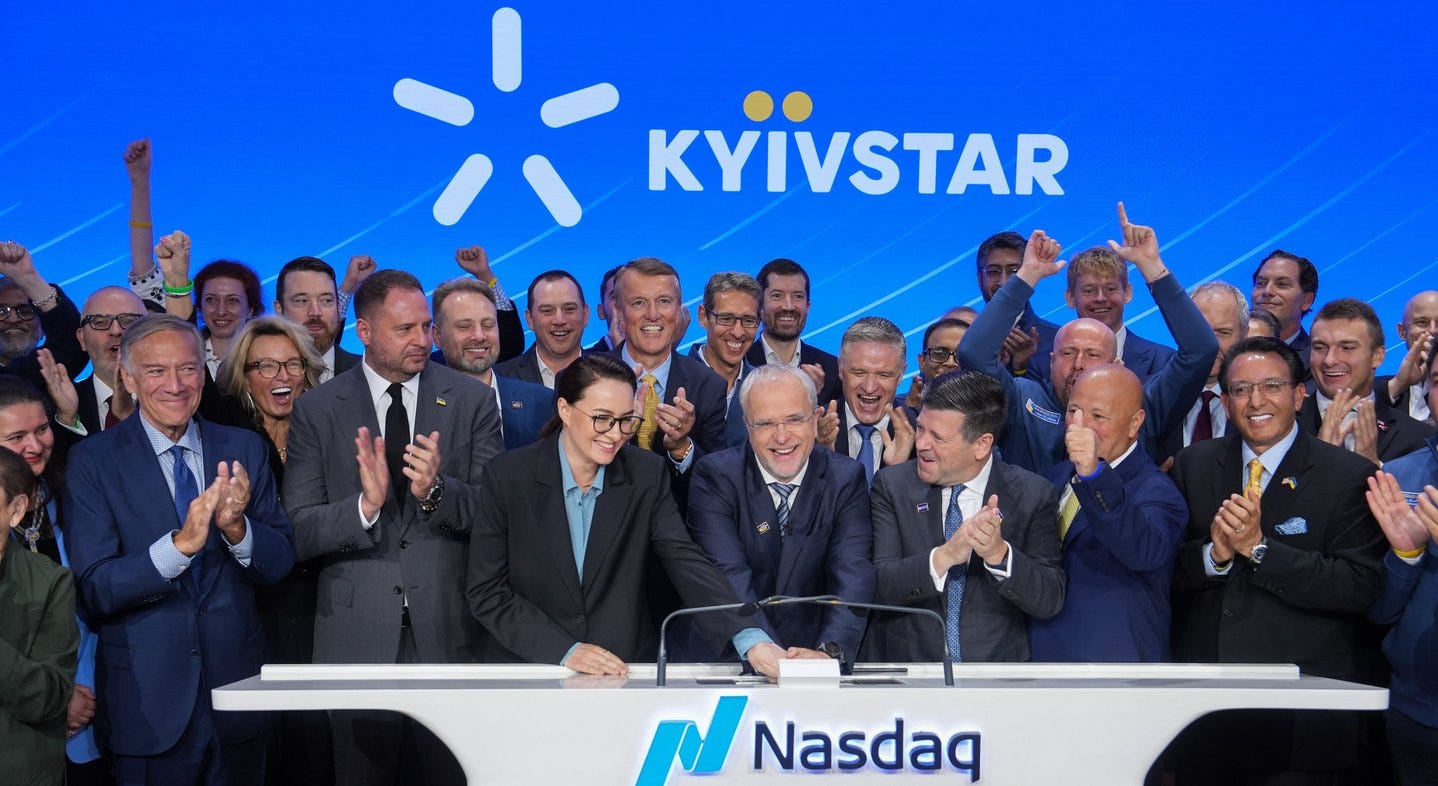
The arrival of artificial intelligence has had an extraordinarily beneficial effect on the opportunities available to the least of these — those of us who, until quite recently, possessed neither corporate communications departments, nor design studios, nor professional factories for the manufacture of reality. Five minutes. Quite literally five minutes — and the historical photograph begins to look like this:
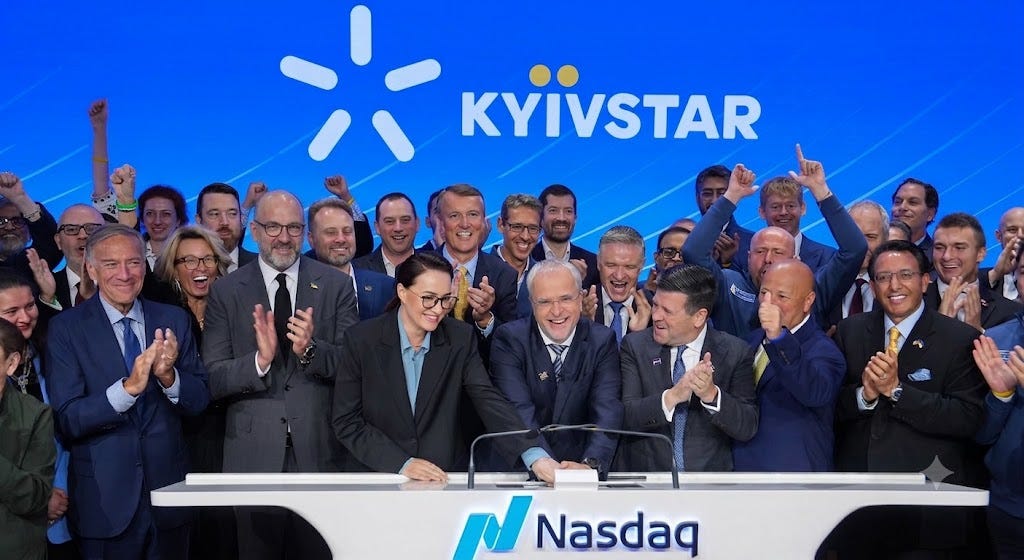
Another five minutes — and like this:
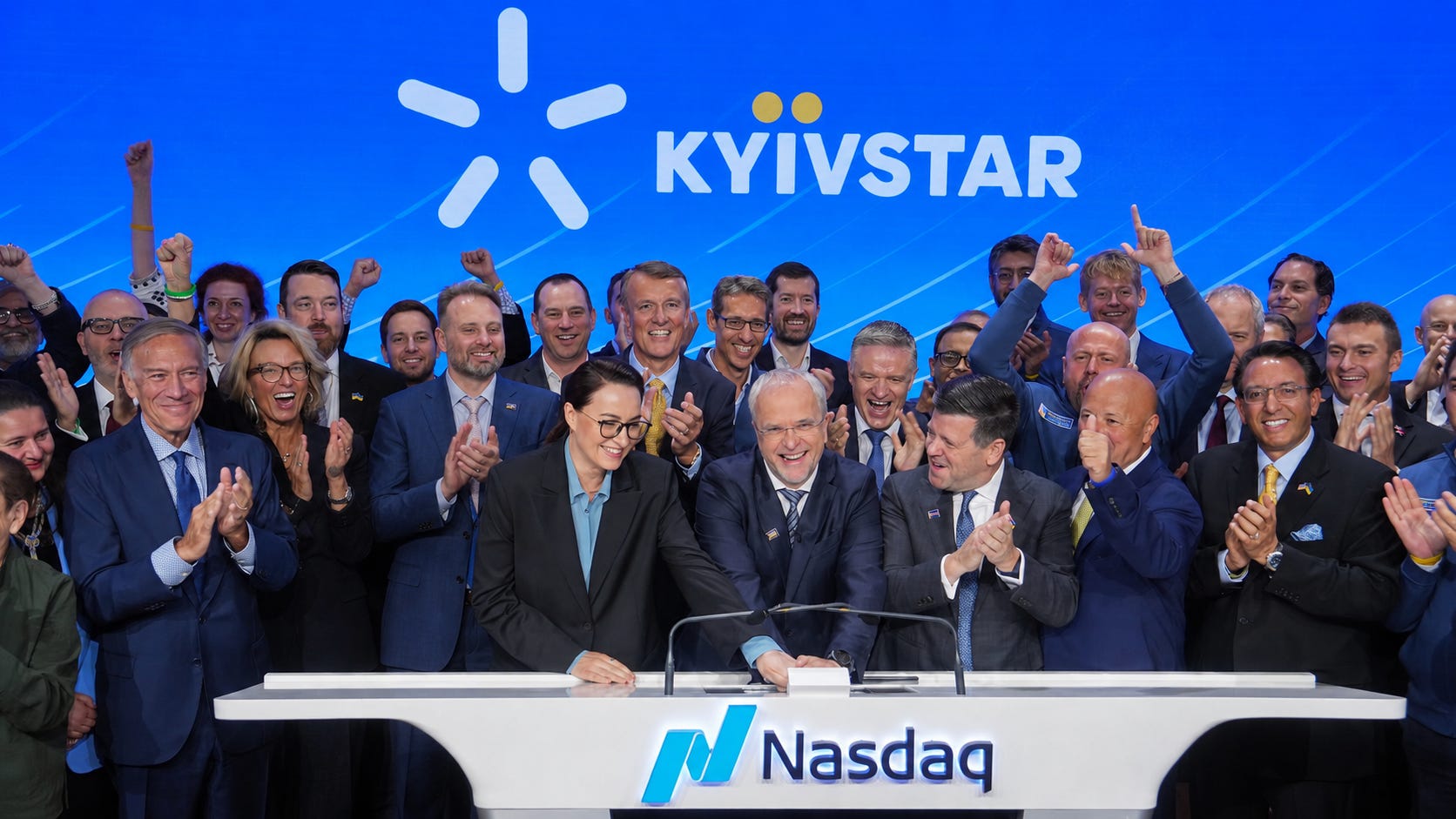
“Post-truth” is already an old-fashioned expression. It belongs to an age when the manufacture of falsehood still required money, an office, and a small staff of trained professionals. We have now entered, perhaps, the age of trans-post-truth. The archive may remain authentic. The photograph may remain authentic. Every person in it may remain authentic.
Only the meaning need be manufactured. And that, nowadays, can be done before dinner.
And for anyone who, after all this, would still like to know how Kyivstar’s adventure on the stock market has actually worked out, here is the chart of its share price over the past year.
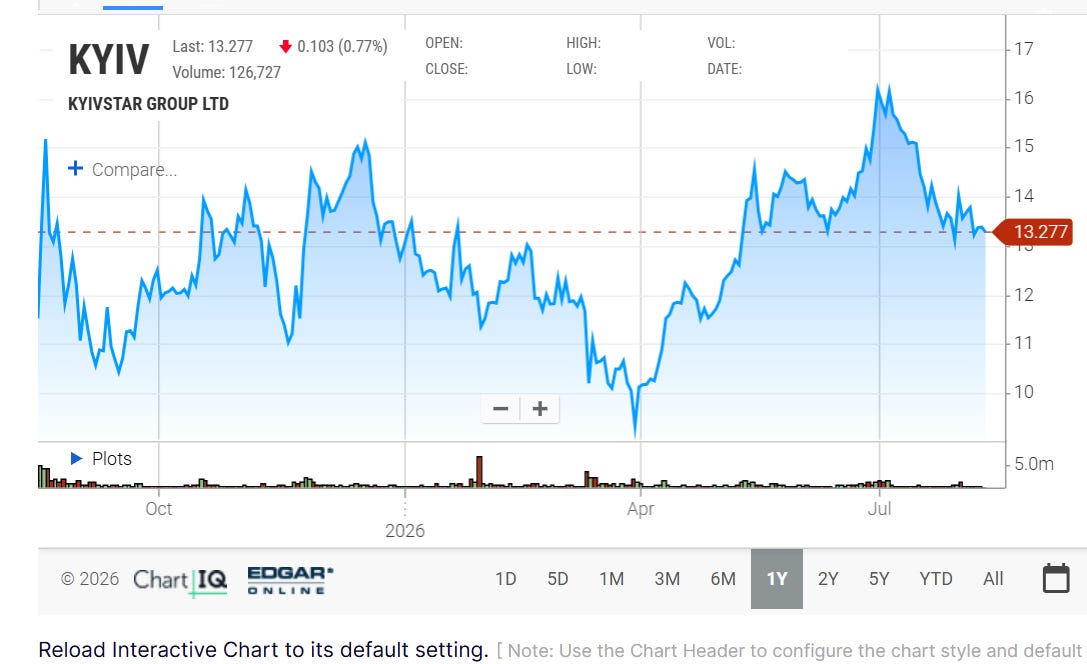
Markets, as we know, have no sense of humor. They do, however, occasionally possess an excellent memory.
